



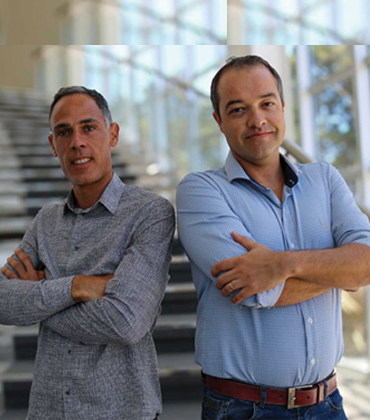
 Esteban Lombardía & Adrián Rovetto, Co-founders
Uovotek closes that gap. It builds biotechnology ventures by combining laboratory execution and venture creation in an integrated model, advancing scientific progress, market validation, and capital deployment together. It is not a service laboratory or accelerator. Uovotek builds its own ventures, structuring each company around capabilities it can directly execute. Its laboratory capabilities drive scientific execution, while its venture model structures and builds companies.
Uovotek integrates scientific execution and venture development within the same model. It originates and builds ventures around unmet biotech needs and recurring technical challenges, without serving external clients or operating as a service provider. An embedded scientific committee evaluates opportunities for relevance, scalability and fit with internal capabilities, without serving external clients or operating as a service provider.
Projects move through a defined sequence from screening to validation and build, with scientific progress, market validation and regulatory pathways advancing in parallel from the outset.
“Uovotek is differentiated by the fact that venture creation and laboratory execution are not separate functions. They are part of the integrated model,” says Morgada.
Integrated Science, Faster Execution
Biotech teams in Latin America often depend on international suppliers for molecular biology capabilities, creating delays in procurement, logistics and scheduling. Uovotek operates in-house platforms for peptide synthesis, DNA sequencing, oligo synthesis and synthetic gene development, reducing reliance on external providers and accelerating core workflows.
Processes that typically take three to six months through external providers can, in selected cases, be completed within two working days. This enables faster iteration cycles where decisions are guided by continuous data. Within Uovotek's integrated model, speed shortens development timelines, extends runway and helps avoid premature scaling.
Uovotek is differentiated by the fact that venture creation and laboratory execution are not separate functions. They are part of the same integrated model.
From Scientific Programs to Investable Ventures
Many biotechnology initiatives face delays in market access in industries dominated by a small number of large players. Uovotek addresses this by integrating commercial validation early in the development process, ensuring ventures are built in line with market demand rather than in isolation.
Uovotek’s model produces companies structured for execution from the outset. Each venture is built with defined technical milestones, a clear product direction and early product-market validation aligned with regulatory and intellectual property requirements. Projects advance only when they meet thresholds for relevance, scalability and execution fit.
PEPTON and Bioseek illustrate the model, securing approximately USD 1.9 million in venture funding and non-repayable public grants. PEPTON focuses on antimicrobial resistance, while Bioseek develops gene-modulating technologies for pest control in agribusiness. Other ventures include SmarCrops, which applies machine learning and AI to portable seed identification and quality control devices, Bioadvance, which develops peptide-based solutions across applications ranging from human health to crop protection and Rescience, which is creating new wellness intervention therapeutics to support healthier aging.
Operating as a Biotech Ecosystem
Uovotek functions as an interconnected system rather than a collection of independent projects. Shared infrastructure, centralized support and cross-venture capabilities allow knowledge, resources and intellectual property to be reused across companies, creating a compounding effect across ventures.
Currently advancing eight ventures in parallel, with multiple securing funding and one reaching commercialization, Uovotek operates on a repeatable and capital-efficient model. By combining scientific infrastructure, venture creation and market validation into a single integrated model, Uovotek establishes a repeatable approach to building biotech companies based on execution, integration and continuous validation.
Advancing Biotech Innovation Through Integrated Research and Venture Development
Biotechnology innovation continues to expand across life sciences, yet the path from laboratory discovery to viable enterprise remains fragmented. Research teams often achieve technical breakthroughs without clear commercial pathways, while early-stage ventures struggle to align scientific progress with funding readiness, regulatory positioning and market access. This disconnect introduces delays, capital inefficiency and missed opportunities for scalable impact. Executives evaluating biotechnology research and startup development partners increasingly prioritize models that compress this gap, aligning scientific execution with venture creation from the outset.
A defining expectation in this space is the ability to connect scientific validation with early market relevance. Programs that advance purely on technical merit without testing real-world demand frequently encounter barriers at later stages. Strong development partners ensure that scientific direction evolves alongside commercial insight, incorporating feedback from potential users, partners and stakeholders early in the process. This parallel progression reduces the risk of building technically sound solutions that lack adoption pathways, particularly in sectors such as healthcare and agribusiness where market entry is complex and concentrated.
Speed of execution has also emerged as a decisive factor. Many research teams remain dependent on external suppliers for critical molecular biology inputs, creating delays that disrupt experimental cycles and extend development timelines. Efficient platforms internalize key capabilities, allowing teams to move through iterative testing and refinement without interruption. Faster experimentation not only accelerates decision-making but also improves capital allocation, ensuring that resources are directed toward scientific advancement rather than logistical overhead.
"Uovotek integrates laboratory infrastructure with venture creation, ensuring that scientific development and company building operate within a unified framework."
Another critical dimension lies in how ventures are structured from inception. Early-stage biotech initiatives often fail because company formation, intellectual property strategy and funding milestones are addressed too late or in isolation. Effective partners integrate these elements into the development process, shaping projects with a clear path to investment readiness. This includes early attention to patent positioning, competitive landscape and milestone design, ensuring that ventures are not only scientifically viable but also structured for scalability and funding engagement.
The ability to leverage shared infrastructure and cross-functional expertise further distinguishes high-performing models. Rather than building each initiative independently, leading platforms create environments where ventures benefit from centralized resources, accumulated knowledge and existing networks. This approach reduces duplication, limits unnecessary expansion and enables disciplined scaling, which is particularly important in regions where access to capital is constrained and execution missteps carry greater consequences.
Within this landscape, Uovotek presents a model that aligns closely with these evolving expectations. It integrates laboratory infrastructure with venture creation, ensuring that scientific development and company building operate within a unified framework. Its process begins with identifying unmet global needs and evaluating whether its internal capabilities can accelerate viable solutions, allowing it to design ventures around technologies it can directly support.
Its structure enables projects to advance through both technical development and business formation in parallel, reducing the distance between proof of concept and investment readiness. Internal platforms for peptide synthesis, DNA sequencing, oligo synthesis and synthetic genes allow faster experimental cycles, shifting development from waiting-based timelines to rapid iteration. The model also incorporates early market validation, intellectual property planning and milestone design, ensuring that ventures are shaped for both scientific and commercial success. This integrated approach positions it as a compelling choice for executives seeking disciplined, capital-efficient pathways to build scalable biotechnology enterprises.
...Read more
Biotechnology Research and Startup Development Services Info
Q1
What Are Biotechnology Research and Startup Development Services?
Biotechnology Research and Startup Development Services combine scientific infrastructure, technical guidance, venture formulation and early execution support for biotechnology projects. They help move ideas from research questions toward structured initiatives with clearer development paths. In practice, the category may cover laboratory capabilities, concept validation, project design, operational planning and support for translating biological innovation into usable products, platforms or companies. This makes the service area especially relevant where science, capital, talent and market readiness need to develop together rather than in separate stages.
Q2
How Does Uovotek Support Biotechnology Research and Startup Development?
Uovotek supports Biotechnology Research and Startup Development Services through a model built around UOVO Labs and UOVO Factory. Its platform is designed to generate and accelerate biotechnology projects, offering state-of-the-art equipment for the biotech ecosystem while operating a startup factory for high-impact companies. Its stated focus areas include environment, food, energy and health, giving its work a broad innovation frame. The structure also allows research support and company-building activity to reinforce one another as projects move from concept to execution.
Q3
Why Are These Services Important for Early Biotechnology Projects?
Early biotechnology work often faces a difficult gap between promising science and investable execution. Biotechnology Research and Startup Development Services help organize that gap by aligning research capacity, technical review, project milestones and resource use. For emerging initiatives, this structure can reduce scattered experimentation and make it easier to assess whether a concept can become a scalable biological solution. It also helps teams clarify assumptions, identify technical bottlenecks and decide which questions must be answered before additional resources are committed.
Q4
What Capabilities Should Organizations Look for in a Biotech Development Partner?
Organizations evaluating biotech development partners should look for access to advanced equipment, disciplined project formulation, scientific talent and a process for refining ideas as data emerges. Biotechnology Research and Startup Development Services are most useful when they connect laboratory work with practical execution, including planning, risk review, intellectual-property awareness, development timelines and potential pathways for broader adoption or international growth. A strong partner should also understand how biological concepts move through uncertainty without losing scientific rigor.
Q5
How Does Uovotek’s Startup Factory Model Fit This Category?
Uovotek’s startup factory model fits Biotechnology Research and Startup Development Services by pairing technology access with a repeatable process for generating, executing and refining initiatives. The company emphasizes efficient use of installed capacity, talent and industrial experience. Its internal approach also reflects a wider scientific ecosystem, supported by an embedded team with backgrounds in chemistry, biology, biotechnology and related technical disciplines. That combination gives the model a practical bridge between research depth, operating structure and venture formation.
Q6
How Can This Category Create Value for the Biotechnology Ecosystem?
Biotechnology Research and Startup Development Services create value by helping promising research mature into organized ventures, product concepts or translational programs. The category supports continuity between scientific discovery and business formation, especially when teams need equipment access, project discipline and development sequencing. For the wider biotechnology ecosystem, this can improve how ideas are tested, prioritized and prepared for long-term impact. It can also support better use of local capacity while connecting biological innovation to global challenges in health, food, energy and the environment.
